Fishdom Solitaire
- 4.7
- Rating
- 5.00M
- Installs
- Free
- Price
 Analysis by App-foxy
Fishdom Solitaire is the kind of puzzle game I open when I want a familiar card session with a little more personality than a standard solitaire table. Developed by Playrix, it places the card-solving activity inside Fishdom’s bright underwater world, so the experience feels lighter and more decorative than a traditional solitaire app. I found the appeal easy to understand: each round gives me a clear, manageable objective, while the aquarium setting makes progress feel more inviting than simply clearing another deck.
This is a free puzzle game for Android, suitable for Everyone, and it runs on devices using Android 5.0 or later. The current version is 3.5.0.0. Its audience is already substantial, with more than five million installs, and the average rating sits at 4.7 from roughly eighty-four thousand ratings. Those figures suggest a well-established game rather than an obscure experiment, but they do not remove the need to look at how it actually feels over repeated sessions.
How Fishdom Solitaire turns small goals into a longer journey
I find the longer journey most appealing when I treat each session as a small step rather than a task to finish quickly. A useful approach is to choose a natural stopping point before I begin, then notice whether the next goal still feels enjoyable or has become an obligation. That distinction helps me keep the aquarium’s steady pull in perspective as I consider how the game fits a shared device.
You May Also Like

 Blood Strike: 2.5 Anniversary
Blood Strike’s Loadouts Turn Every Drop Into a Tactical Gamble
A close look at Blood Strike’s custom loadouts: how fast access to signature weapons reshapes its battle royale rhythm, rewards preparation, and narrows the gap between fights.

 Pandora - Music & Podcasts
Pandora’s Music Is Easy to Start, but Harder to Recover
Pandora’s strength is its low-effort path from a seed to a station. Its weak spot is how much confidence it asks you to place in connection, setup, and quiet recovery.

 8 Ball Pool
 Is Built on Rivalries, Rematches, and Routine
A close look at the rivalries, rematches, shared routines, and unanswered safety questions that turn a quick pool match into a persistent mobile community.

 Samsung Music
’s Quiet Strength Is Playing What You Already Own
Its reach comes less from spectacle than from dependable access to a personal library. That simplicity is both the app’s strongest retention engine and its ceiling.

 AccuWeather: Weather Radar
AccuWeather Review: A Quick, Clear Forecast for Everyday Decisions
For everyday plans, the best forecast is the one you can understand quickly. AccuWeather makes rain timing, radar, and local conditions easy to act on, with a few trade-offs.

 Hill Climb Racing
Why Hill Climb Racing Still Turns Crashes Into One More Run
A tiny car, a bumpy hill and one more upgrade: Hill Climb Racing keeps resurfacing because its simple chaos makes every near-miss feel personal.
More From Our News Desk



The first sessions give me a reason to keep playing
The early appeal comes from the combination of short card puzzles and visible aquarium-themed progress. In a conventional solitaire game, completing a hand can be satisfying but often feels self-contained. Here, the underwater presentation gives the result a stronger sense of continuity. I am not only trying to finish the current layout; I am also encouraged to see what comes after it.
That structure works particularly well for someone who plays in small gaps during the day. I can start a round while waiting for an appointment, complete a little progress, and stop without needing to commit to a long session. The game does not demand the same attention as a story-heavy adventure, yet it offers more context than an endless sequence of disconnected card deals.
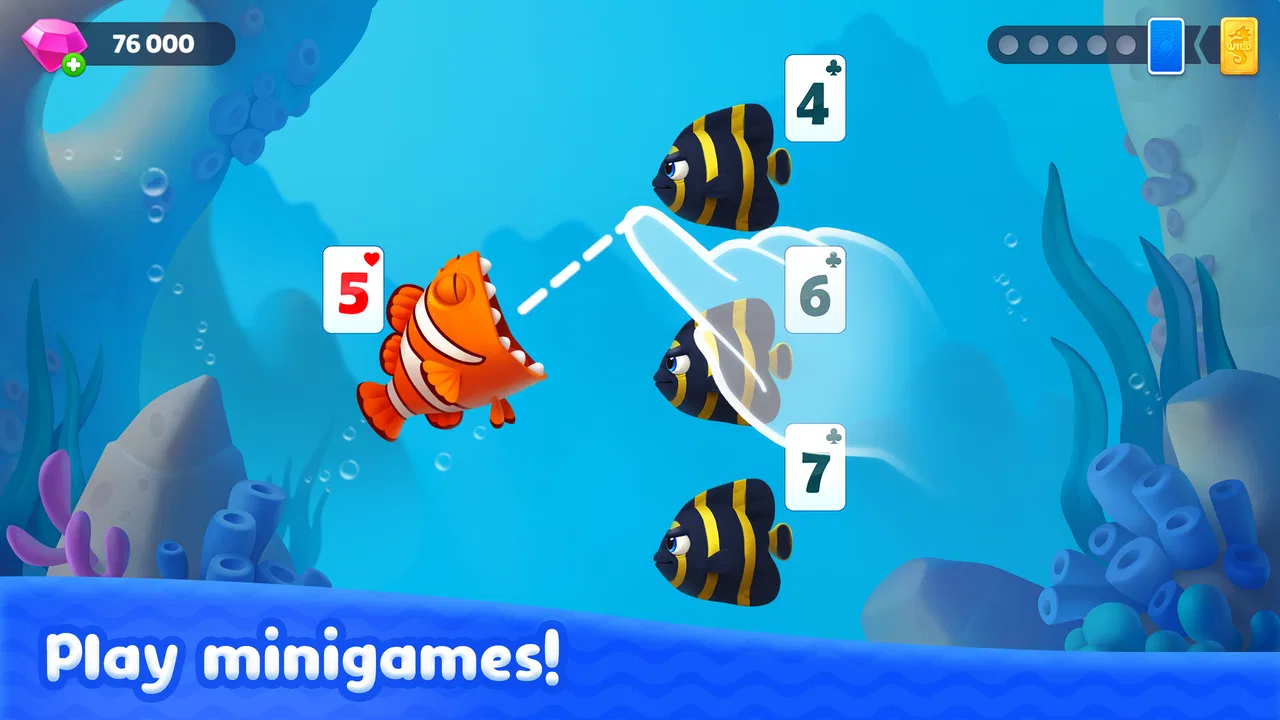
The opening goals are easy to understand because the core action remains recognizable. I do not need to learn a complicated control scheme or study a large collection of rules before making useful moves. Cards are selected with straightforward taps, and the visual design helps me identify what is available. For a casual player, that low entry barrier is one of the strongest reasons to try it.
There is also a useful psychological difference between a plain win counter and a themed setting. Seeing the aquarium world develop gives each completed puzzle a little more weight. It is not a substitute for deep strategy, but it makes routine victories feel connected. I noticed that this matters most during short sessions, when I may not have enough time to appreciate a large feature or a lengthy challenge.
Progress is easy to read, even when the puzzle is not
One of the better design choices is the way the game communicates forward movement through its presentation. The cards provide the immediate feedback, while the aquarium theme supplies the longer-term visual motivation. That separation keeps the moment-to-moment task clear: first solve the layout, then enjoy the sense that the broader world is moving forward.
For me, this creates a useful rhythm. I begin with a practical target, such as clearing the current arrangement, and then receive a softer reward from the surrounding setting. The two layers do not compete for attention. The cards remain the main activity, while the fish and underwater atmosphere prevent the experience from becoming visually flat.
A tip I would give new players is to treat the aquarium presentation as a progress signal rather than rushing through it. The decorative layer is part of what distinguishes this game from a basic solitaire download. If I focus only on rapidly clearing cards, I lose some of the reason this particular version exists. Taking a moment to notice the setting also makes repeated sessions feel less mechanical.
The progress design is especially suitable for players who like gentle collections of small achievements rather than one large objective. It gives me enough direction to return, but it does not require me to remember a complicated plot or maintain a detailed build plan. That makes the game approachable for relaxed play, although players seeking a highly strategic progression system may find it comparatively light.
The challenge grows through decisions, not complicated rules
The central challenge comes from choosing which cards to expose and which moves to preserve. Even when the rules feel familiar, the order of actions can change the result. A careless tap may remove a useful option too early, while a more patient sequence can open another route through the layout. This is where the game becomes more than a purely automatic card-clearing exercise.
I found that the best way to play is to pause briefly before taking an obvious move. The most visible card is not always the most valuable one to remove. When several choices are available, I look for the move that reveals more information or keeps multiple possibilities open. That habit is simple, but it makes the puzzles feel more deliberate without turning them into exhausting calculations.
This is one of the game’s less obvious strengths: the bright presentation can make it look almost effortless, yet the card order still asks for attention. I can play casually, but I get better results when I stop treating every available move as equally good. The game rewards a little planning while remaining accessible to people who do not normally play demanding puzzle titles.
At the same time, I would not describe the strategy as exceptionally deep. Players who prefer complex solitaire variants, large decision trees, or puzzles with several interacting systems may eventually want something more rigorous. Fishdom Solitaire is designed around approachable decisions and steady entertainment, not around the kind of analysis that can occupy a serious card-game enthusiast for hours.
The difficulty curve feels friendly, with pressure appearing gradually
The pacing is strongest when I approach it as a sequence of manageable tests. Early rounds help establish the rhythm, while later play asks me to pay closer attention to card order and available options. That gradual increase is important because the game’s charm depends on remaining welcoming. If the challenge became severe too quickly, the underwater setting would not be enough to keep the experience relaxing.
When a round becomes difficult, I try not to replay it immediately with exactly the same habits. Instead, I look at where I spent useful cards and whether I acted too quickly when several paths were open. This turns failure into a practical lesson. The game is more enjoyable when I treat a lost round as information about my choices rather than as a reason to tap randomly through the next attempt.
There is a trade-off here. A gentle difficulty curve makes the game suitable for a broad audience, including people who want a calm puzzle during a break. However, it can also make the experience feel less urgent for players who want constant high-level pressure. The right expectation is a relaxing card challenge that can become thoughtful, not a competitive solitaire simulator built around relentless difficulty.
I also appreciate that the visual theme does not require me to understand a complicated fictional universe before enjoying the cards. The setting adds flavor, but the basic activity remains immediately readable. That makes it easier to recommend to someone who likes casual puzzles but may not want a game with extensive tutorials, dense menus, or a large amount of story text.
Where the game may encourage longer sessions
The same small-goal structure that makes Fishdom Solitaire easy to return to can also create retention pressure. A completed puzzle naturally makes me curious about the next one, and the aquarium setting gives that curiosity a visible destination. The game is good at making “one more round” feel reasonable, especially when I have already made progress and want to finish on a satisfying result.
That is not necessarily a flaw, but it is worth recognizing before installing it. Players who prefer games that end cleanly after a single session may find the ongoing progression difficult to ignore. I would set a personal stopping point before starting, particularly when playing late in the evening. The rounds may be short, but the desire to continue can outlast the time I originally planned to spend.
The game is free to download and includes in-app purchases ranging from $0.99 to $99.99 per item. That range makes it important to approach the optional spending carefully. My advice is to decide in advance whether you want to play entirely at no cost or whether you are comfortable buying occasional extras. The free entry is useful for testing the card style, but a player who dislikes purchase prompts or progression pressure should pay attention to how the game fits their habits.
For parents, the Everyone content rating makes the game broadly approachable from an age-classification perspective. Still, age suitability and spending habits are separate questions. If a child uses the device, I would use the device’s purchase controls and discuss whether buying items is allowed. That is a practical precaution for any free-to-play game with optional purchases, and it matters here because the available item range extends from small amounts to much larger ones.
How it compares with ordinary solitaire and other puzzle games
Compared with a plain solitaire app, Fishdom Solitaire offers a stronger sense of place and a clearer reason to care about what happens after a hand. A basic alternative may be better if I want a minimal interface, faster access to cards, or a purely traditional experience without decorative elements. On the other hand, this game is the better fit when I want the familiar card activity wrapped in a more colorful, goal-oriented setting.
Compared with match-three puzzle games, it feels less dependent on rapid visual scanning and more dependent on sequence planning. Match-three titles often reward quick pattern recognition and chain reactions. Here, I spend more time deciding which card to use and which option to preserve. Someone who enjoys calm, turn-by-turn thinking may prefer this approach, while a player looking for constant movement and explosive combinations may find it too measured.
It also differs from story-driven puzzle adventures. Fishdom Solitaire gives me atmosphere and a sense of progression, but the card layout remains the main attraction. I should not install it expecting a narrative game with elaborate character development. Its strength is the repeatable puzzle loop, supported by the aquarium theme rather than replaced by it.
That distinction helps identify the right audience. I would recommend it to a casual solitaire player who wants more visual motivation, someone who enjoys short puzzle sessions, or a Fishdom fan curious about a card-based format. I would skip it in favor of a more traditional app if I wanted complete simplicity, and I would choose a deeper strategy game if I needed complex planning, competitive depth, or a demanding long-term challenge.
A realistic everyday use case
Imagine having fifteen minutes before leaving for work. I can open the game, play a round or two, and stop after reaching a natural break. The underwater setting makes the session feel more pleasant than staring at a bare card table, while the familiar rules mean I do not spend the whole break learning mechanics. If a puzzle goes badly, I can close the app without losing the value of the entire session; if it goes well, I finish with a small sense of progress.
It also works during a quiet evening when I want something more engaging than passive scrolling but less demanding than a large adventure game. I can concentrate on the card choices, yet I do not need to remember a complicated objective from the previous day. That low memory burden is a meaningful advantage for intermittent players.
My practical tip is to use the game as a deliberate short-session activity rather than an automatic filler. Decide how many rounds you want to attempt, avoid making moves just because they are available, and treat the aquarium progress as a bonus rather than a reason to ignore your stopping point. This approach preserves the relaxing side of the game and reduces the chance that the “next puzzle” rhythm takes over the evening.
Small habits that improve the card experience
First, I scan the whole visible layout before committing to the easiest-looking move. The goal is not to plan every action several steps ahead, but to notice whether one choice opens more cards than another. This is particularly helpful when the board offers multiple routes and I am tempted to clear the first obvious option.
Second, I avoid spending useful opportunities simply to make the board look cleaner. A move that removes one card may be less valuable than a move that exposes a hidden continuation. Thinking in terms of future access, rather than immediate disappearance, makes the puzzles more consistent.
Third, after a failed attempt, I change one decision pattern instead of replaying mindlessly. Perhaps I used a flexible card too early, or perhaps I ignored an alternative route. This turns the retry into a small experiment and keeps the challenge from becoming frustrating repetition.
Finally, I separate enjoyment of the theme from pressure to progress. The aquarium atmosphere is a reason to return, but it should not dictate spending or endless play. If I am no longer making thoughtful card choices, that is usually a good sign that the session has run its course.
What the current package means for device choice
The Android requirement is modest, with support beginning at version 5.0, so the game is positioned for a wide range of Android devices. The current release, 3.5.0.0, is the version I would look for when checking compatibility before installing. As with any colorful puzzle game, the quality of the experience will still depend on the individual phone or tablet, especially the size of the screen and how comfortably cards can be read.
A larger display is preferable if I want to inspect several card options at once. On a small phone, the game remains convenient for quick sessions, but I may need to pay closer attention to taps and visual spacing. That is not a reason to avoid it; it simply affects whether I see it as a pocket game for short breaks or a more comfortable tablet activity.
The free price makes trying it straightforward, and the Everyone rating broadens its potential audience. The more important decision is whether the blend of solitaire, decorative progression, and optional purchases matches my preferences. The download itself is easy to justify for curious casual players, but long-term enjoyment depends on liking the repeatable card loop rather than merely liking the Fishdom name.
My progression verdict
Fishdom Solitaire sustains play through a sensible combination of early clarity, readable progress, gradual challenge, and a setting that gives ordinary card victories more personality. I like that the goals are easy to grasp and that the aquarium presentation provides a reason to care about the next round. The game does not need complicated systems to make short sessions feel connected.
Its limitations are equally clear. The strategy remains approachable rather than profound, the ongoing progression can encourage longer sessions than planned, and the in-app purchase range means careful spending habits are worthwhile. Players wanting a pure solitaire tool, a highly competitive card challenge, or a more substantial story should look elsewhere.
For my tastes, Fishdom Solitaire works best as a relaxed puzzle companion: familiar enough to start immediately, colorful enough to avoid feeling sterile, and structured enough to make a few spare minutes feel purposeful. I would recommend it to friends who want solitaire with a decorative sense of progress, provided they are comfortable setting their own limits around playtime and purchases.
My final advice is to judge it by the first several sessions rather than by the aquarium theme alone. If you enjoy thinking about card order and like seeing small goals accumulate, the format has staying power. If you want every round to deliver deep strategy or fast excitement, the gentle pacing may feel too restrained. The best reason to install it is the balance between familiar card decisions and an inviting underwater journey.
FAQs for Fishdom Solitaire
01What is Fishdom Solitaire, and how is it played?
Fishdom Solitaire combines classic solitaire card gameplay with aquarium decoration and management. You complete card layouts by selecting cards in sequence, usually one rank higher or lower than the current card, while using boosters when available. Winning levels earns rewards that can be spent on fish, decorations, and aquarium improvements, adding a light simulation element to the familiar card-game format.
02Is Fishdom Solitaire free to download and play?
Fishdom Solitaire is generally free to download and offers its main levels without an upfront purchase. However, it includes optional in-app purchases for extra lives, boosters, coins, or other resources. Progress can usually be made without spending money, although difficult levels and waiting periods may encourage purchases. Check your device’s payment settings before playing, especially if children use the device.
03Does Fishdom Solitaire require an internet connection?
An internet connection may be needed for certain features, including advertisements, in-app purchases, cloud synchronization, events, updates, and promotional rewards. Some solitaire levels may remain playable offline, but availability can vary by device and game version. For the most reliable experience, use a stable connection when launching the game or accessing online features.
04Are there advertisements or energy limits in Fishdom Solitaire?
Fishdom Solitaire may include advertisements, particularly as optional videos that provide extra rewards, and the game can also use lives or similar limits that restrict how quickly you attempt levels. These systems are common in free-to-play puzzle games. You can often continue playing by waiting, using earned resources, or choosing optional purchases, depending on the current game version.
05Is Fishdom Solitaire suitable for children and does it protect personal data?
Fishdom Solitaire is easy to understand and generally suitable for players who enjoy casual card games, but parents should review the age rating and supervise younger users because the app may contain advertisements and optional purchases. The game may collect technical, usage, and purchase-related information as described in its privacy policy, so review the current policy before installing.
Pros
- Relaxing solitaire gameplay with an enjoyable underwater aquarium theme.
- Aquarium decorations provide a satisfying sense of progression.
- Easy-to-learn controls make it accessible for casual players.
- Short levels fit well into quick gaming sessions.
- Colorful visuals and cheerful animations make the game feel lively.
Cons
- Lives and boosters can limit how long you play in one session.
- Later levels may become difficult without using power-ups.
- Some rewards and features require watching optional advertisements.
- In-app purchases can become tempting when progress slows down.
- The game may feel repetitive if you prefer deeper card strategy.

Fishdom Solitaire
Gallery